Americana Campaign

INTRODUCTION
Medicine is among the most heavily governed fields in modern life. What reaches a patient has been tested, standardized, named, labeled, and regulated under rules assembled across more than a century, many of them written in the aftermath of harm. Within the field, the standard of evidence is demanding. The public-facing layer of it, the way medicine is described, explained, and marketed, is seldom subject to the same scrutiny.
This publication is an attempt to narrow that distance. Its subject is the history, science, regulation, and craft of medicine and its making, examined with the care the material requires and set down in language a non-specialist can follow. The work is held to a standard of accuracy, and it gives full context before it draws conclusions.
A note on who publishes it. System Laboratories operates in compounded medication, so its interest in these subjects is not disinterested. We state as much at the outset, on the principle that a reader is owed the knowledge of who is speaking and why. What appears in these pages is meant to stand on the accuracy of its claims and the quality of its sources, and to be checked against both.
We begin with history, since it is the most honest foundation available. The inaugural feature traces the development of pharmacy in the United States, from the earliest domestic apothecaries through the chemistry and the law that produced the modern field. The questions a pharmacy exists to answer have changed less over three centuries than the means of answering them, and the history makes that unusually clear.
It is written for the reader who wants to understand the subject, and it asks to be read on those terms.

A BRIEF HISTORY ON WELLNESS
Before there were prescriptions, there were promises. Long before a single tablet was pressed or a label printed, the relationship at the center of medicine was a human one: a person who felt unwell, and another person trusted to know what might help. That second person, known across the centuries as the apothecary, the chemist, the druggist, or the pharmacist, has gone by many names, yet the role has changed remarkably little at its core. It is the role of an intermediary between raw knowledge and real life, the figure who translates the abstractions of medicine into something a human being can hold, measure, and use.
The American pharmacy as we recognize it today is a relatively young institution, but it is the inheritor of an extraordinarily long lineage. Its instincts were formed in medieval guild halls and Renaissance dispensaries, refined in colonial shopfronts, codified by federal law, and reshaped again and again by science, commerce, and public expectation. To understand why a modern wellness company like System exists, and why it organizes itself the way it does, it helps to trace that lineage from the beginning, or at least from the moment a few hundred years ago when the practice began to resemble something we would recognize.
The history of pharmacy moves in cycles. Personalization gives way to standardization and then circles back. Trust is earned, betrayed, and rebuilt. A persistent tension runs throughout between the medicine made for the many and the medicine made for the one. The arc bends toward more safety, more rigor, and more accountability, though it does so unevenly, often in response to tragedy, and always against the backdrop of a public deciding whom it is willing to trust with its health.
What follows is a brief history of that arc. It begins with the broad sweep of Western medicine from the late medieval and Renaissance periods. It pauses at a small shop in colonial Philadelphia that helped set the template for the American pharmacy. And it ends in the present, with the regulatory and cultural conditions that made a company like System both possible and, its founders would argue, necessary.

A 17th-century apothecary's shop, oil on canvas by Giovanni Domenico Valentini, c. 1639–1715. An alchemist instructs his apprentice amid blue ceramic vessels, distillation equipment, and organic preparations. Science History Institute, Eddleman Collection.
PART I OF III
THE INHERITED WORLD OF THE FOUR HUMORS
For most of recorded Western history, the theory of disease that physicians and apothecaries worked within was inherited from antiquity. The dominant framework, traceable to the Greek physician Hippocrates and elaborated by the Roman physician Galen in the second century, held that the body was governed by four "humors," namely blood, phlegm, yellow bile, and black bile, and that illness arose when these fluids fell out of balance. The Persian polymath Ibn Sina, known in the West as Avicenna, wove these humors together with the classical elements of air, water, fire, and earth, producing a system that would shape medical and pharmaceutical practice across Europe and the Islamic world for centuries.
Within this worldview, treatment was largely a matter of restoring balance. Remedies designed to induce sweating, vomiting, salivation, or bleeding were commonplace, and the apothecary's expertise lay in knowing which preparations produced which effects and how to compound them safely. The materia medica of the late medieval and early Renaissance apothecary was overwhelmingly botanical, supplemented by minerals and, in some traditions, animal-derived substances. It was knowledge passed down through apprenticeship, recorded in herbals, and both guarded and standardized by the guilds.
The daily work of the apothecary was a demanding craft. Raw plant material had to be identified, harvested or purchased, dried, ground, infused, distilled, or otherwise transformed into a usable form. The apothecary measured and combined ingredients by hand, often to formulas that varied from one authority to another, and produced an array of preparations including powders, pills, syrups, ointments, tinctures, and electuaries, each requiring its own technique. The shop was at once a laboratory, a storehouse, and a counter. Because so much depended on the individual practitioner's skill and honesty, the apothecary's reputation was inseparable from the safety of what he sold. A careless or unscrupulous maker could do real harm, and the absence of any external check meant that, for centuries, the public's only protection was the competence and conscience of the person behind the counter. The long history that follows can be read, in large part, as the slow construction of safeguards to replace that fragile reliance on individual virtue with something more dependable.
By the late Middle Ages, the practice of preparing and selling medicines had become organized enough to require rules. Across European cities, apothecary guilds and professional societies emerged to standardize training, regulate apprenticeships, enforce quality standards for the medicines sold, and uphold a basic professional ethics. These guilds were, in effect, the earliest infrastructure of pharmaceutical safety: bodies that decided who was qualified to prepare medicine and what counted as an acceptable preparation.
The drive toward standardization produced one of the most consequential documents in the history of pharmacy. In 1498, the Guild of Apothecaries and the Medical Society of Florence published the Nuovo Receptario, widely regarded as one of the first official pharmacopeias: a binding reference establishing standard formulas, ingredients, and methods for an entire jurisdiction. The principle it embodied was revolutionary in its modesty, holding that a medicine should be the same, made the same way, regardless of which hand prepared it. The pharmacopeia is the ancestor of every quality standard and every published monograph that governs medicine-making today.
In England, the institutional independence of the profession arrived in 1617 with the founding of the Worshipful Society of the Art and Mystery of the Apothecaries, which separated apothecaries from the grocers' company and established examinations covering the preparation, dispensing, handling, and compounding of medicines. For the first time in English practice, the apothecary was recognized as a distinct professional, subject to scrutiny and accountable for competence.

An apothecary's shop, fresco by an unknown Italian master, 1489–1502. Labeled medicine jars, dried herbs, and hanging wax goods line the shelves as an attendant weighs goods for a robed customer. Castello Challant, Issogne, Valle d'Aosta.
PARACELSUS AND THE CHEMICAL TURN
The intellectual ferment of the Renaissance did not leave medicine untouched. Its most disruptive figure was the Swiss-born physician and alchemist who styled himself Paracelsus (1493–1541). Where the medical establishment revered the ancient authorities, Paracelsus attacked them, famously and provocatively burning the works of Avicenna and Galen before his students at Basel. He rejected the strict humoral model, argued that disease could come from outside the body, and championed an approach grounded in chemistry rather than pure botany, introducing the use of mineral and metal-based remedies.
Paracelsus is rightly remembered as a controversial figure; his thought mixed genuine empirical insight with mysticism and astrology. But one of his contributions has proven foundational to pharmacy and toxicology alike: the recognition that the dose determines whether a substance is a remedy or a poison. The idea that quantity, precisely measured, is the difference between healing and harm is now so basic to medicine that it is easy to forget it had to be discovered and argued for. Over the decades following his death, his chemical preparations gradually entered the mainstream. By the 1560s, pharmacopeias printed in German-speaking regions were incorporating chemical remedies, and by the early seventeenth century, official references such as the 1618 Pharmacopoeia Londinensis devoted entire sections to chemical preparations, listing more than a hundred such formulas alongside the traditional herbal ones.
THE SCIENTIFIC REVOLUTION AND THE SLOW MARCH TOWARD EVIDENCE
The Renaissance also reshaped medicine into a more humanistic and empirical enterprise. Classical texts were re-examined rather than simply revered, the printing press accelerated the spread of knowledge, and universities grew more receptive to anatomical study and experiment. Andreas Vesalius produced detailed anatomical illustrations that corrected centuries of error; William Harvey's work, published in 1628, began to overturn the Galenic understanding of the cardiovascular system by describing the circulation of the blood. Later in the seventeenth century, the microscope opened an invisible world: Robert Hooke and Antonie van Leeuwenhoek observed cells and "animalcules," though the role of microorganisms in causing disease would not be understood for nearly two more centuries.
These advances did not immediately transform the apothecary's shelf. The remedies of the seventeenth and eighteenth centuries were still largely compounded by hand from natural materials, still organized around theories that would later be discarded. But the method was changing. Empirical observation, measurement, and experiment were displacing inherited authority as the test of what was true. That methodological shift, patient and cumulative and often invisible in any single generation, is what eventually carried pharmacy from a craft of tradition to a science of evidence.

Pages from the 1597 edition of the Ricettario Fiorentino di Nuovo Illustrato, an early Florentine pharmacopoeia. The frontispiece appears alongside a recipe entry for saffron, one of many medicinal ingredients catalogued in the text. ETH-Bibliothek Zürich.
By the early nineteenth century, the history of pharmacy as a modern and independent science had begun in earnest. The isolation of active compounds from plants, the rise of organic chemistry, and the growing professional separation of the pharmacist from the physician set the stage for everything that followed. Pharmacy had long been the art of preparing what tradition prescribed; it was becoming the science of understanding what medicines were made of, and why they worked.
This shift had two profound consequences. The first was conceptual. As chemists began to isolate the active principles of long-used botanical remedies in the early 1800s, extracting pure compounds from plants that healers had relied on for generations, medicine moved from treating with whole plants of variable strength toward treating with defined substances of measurable potency. Where a remedy had once been a leaf or a root whose effect depended on soil, season, and preparation, it increasingly became a known quantity that could be standardized, dosed precisely, and eventually manufactured. The second consequence was professional. As the knowledge required to prepare medicines deepened, the roles of the physician who diagnosed and the pharmacist who prepared and dispensed drew apart into distinct vocations, each with its own training, ethics, and accountability. The apothecary-generalist of the colonial shop was giving way to the specialist pharmacist, and in time to the regulated profession and the industrial manufacturer that would define the twentieth century.

Interior of a late 19th-century American pharmacy, c. 1870. Ornate carved shelving, glass display cases, and rows of ceramic jars reflect the scale and ambition of the era's apothecary trade. The New York Public Library Digital Collections.
PART II OF III
DOMESTIC APOTHECARY
Many threads of early American institutional life run through one city, and pharmacy is no exception. The story of the modern American pharmacy begins, by most accounts, in Philadelphia. The reasons are partly accidental and partly structural: Philadelphia was among the largest and most cosmopolitan cities in colonial America, a center of trade, learning, and the kind of civic ambition that produced hospitals, colleges, and professional societies decades before they appeared elsewhere.
European settlers had brought the apothecary tradition with them across the Atlantic, and by the early eighteenth century, apothecary shops were appearing in colonial urban centers, most prominently Philadelphia and Boston. These were not pharmacies in the narrow modern sense. They were often general establishments offering both medical advice and medicines, run by physicians, surgeons, merchants, or trained immigrants, reflecting a colonial economy still heavily dependent on Britain for drugs and ingredients. The colonial apothecary was a generalist and an importer as much as a compounder, and the line between selling medicine and practicing medicine was blurry.
Into this world stepped an Irish immigrant named Christopher Marshall. Born in Dublin in 1709, Marshall came to the colonies in 1727 and settled in Philadelphia, where he worked as a chemist and pharmacist. In 1729, he established his apothecary shop, an establishment widely cited as one of the first known apothecaries in colonial America and the first of its kind in Philadelphia.
It is worth a careful word here. History rarely offers clean "firsts," and the historical record names other early figures, including Elizabeth Gooking Greenleaf, who ran an apothecary in Boston in 1727. Marshall's shop is best understood as one of the earliest American apothecaries, and certainly one of the most important and enduring, rather than as the very first in any absolute sense. Its true significance lies less in the date on its door than in what it became over the ninety-six years it operated.

Christopher Marshall's apothecary shop, established in Philadelphia in 1729. Among America's earliest pharmacies, it later became a Revolution-era supply depot and was managed by granddaughter Elizabeth Marshall, one of the country's first women pharmacists. National Library of Medicine.
Over nearly a century, the Marshall Apothecary grew into far more than a retail counter. It became a leading retail pharmacy, a nucleus of large-scale chemical manufacturing, a practical training school for pharmacists, and an important supply depot during the American Revolution. In other words, it prefigured nearly every function the American pharmaceutical enterprise would later separate into distinct industries: the corner drugstore, the manufacturer, the educational institution, and the strategic supplier. Marshall himself earned the nickname "the fighting Quaker" for his role in the Revolution, and his sons Charles and Christopher Jr. carried the business and its standards forward.
The apothecary also produced a notable milestone in the history of the profession: Marshall's granddaughter, Elizabeth Marshall, took over management of the family enterprise and is frequently recognized as America's first woman pharmacist. In an era when professional life was almost entirely closed to women, a Philadelphia apothecary became, quietly, a place where a woman could practice a skilled trade and run a respected business.
The deeper significance of the Marshall Apothecary lies in the model it helped establish. The colonial apothecary was, at its best, a trusted advisor embedded in a community, someone who dispensed remedies, offered counsel, prepared most medicines personally, and stood behind their quality. Early American pharmacists were "more than just dispensers of medicine; they were trusted advisors in their communities." That combination of craft, counsel, and accountability became the cultural DNA of American pharmacy.
The institutions that followed built directly on this foundation, and Philadelphia again led the way. As physicians and pharmacists alike grew concerned about the inconsistent quality of both medicines and practitioners, they sought standardization. In 1820, that impulse produced the United States Pharmacopeia (USP), a body established to develop and publish uniform standards of practice and quality for medicines, a function it continues to perform today. The principle was the same one the Florentine guild had articulated in 1498: a medicine should be reliable regardless of who makes it.
Formal education followed close behind. In 1821, the Philadelphia College of Pharmacy was founded, becoming America's first pharmacy school and first pharmacy organization, and shifting the path into the profession from informal apprenticeship toward formal institutional training. National organization came next: in 1852, the American Pharmaceutical Association (now the American Pharmacists Association, APhA) was established as the country's first national pharmacy association.
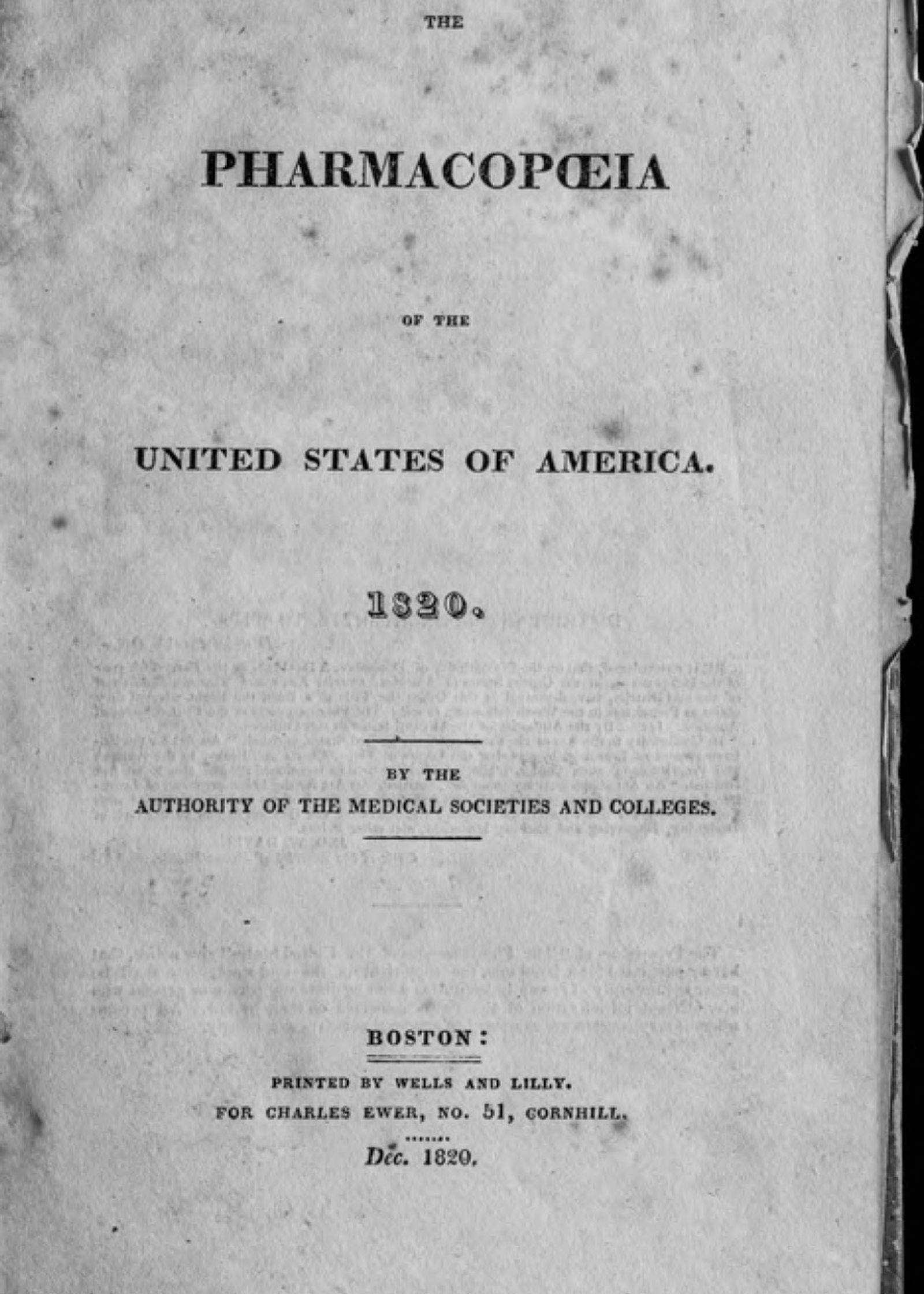
Title page of the first Pharmacopoeia of the United States of America, published in Boston, December 1820. Issued by the authority of American medical societies and colleges, it established the first national drug standards for the new republic. United States Pharmacopeial Convention.
In the space of roughly a century and a quarter, from Marshall's 1729 shop to the founding of a national professional body in 1852, American pharmacy transformed from a scattering of import-dependent colonial shops into a self-governing profession with standards, schools, and institutions. The apothecary's old virtues of quality and trust were no longer left to individual conscience; they were being written down, taught, and enforced.
The institutional milestones of this period were complemented by quieter, structural ones. In 1751, Pennsylvania Hospital was founded in Philadelphia as colonial America's first hospital, and the following year, in 1752, it opened what is generally recognized as the first hospital pharmacy in the colonies, with apothecaries serving as caregivers who blended the preparation of medicines with direct patient care. The hospital pharmacy joined the community apothecary as a second template for American practice, one oriented toward institutional medicine rather than the retail counter.

Dr. Joseph P. Remington's pharmacy library, c. early 1900s. Remington chaired the USP Committee of Revision from 1901 to 1918, overseeing significant expansion in national drug standards. American Institute of the History of Pharmacy.
Equally important was the system by which the profession reproduced itself. For most of the eighteenth and early nineteenth centuries, the path into pharmacy ran through apprenticeship: a young person would train for years under an established pharmacist, learning the craft by practice rather than in a classroom. The Marshall Apothecary, with its dual role as a working shop and a practical training school, exemplified this model. Apprenticeship had real virtues. It transmitted hands-on skill and embedded the apprentice in a community of practice. It also meant, however, that the quality of a pharmacist depended heavily on the quality of his master, with no common standard across the trade. The founding of the Philadelphia College of Pharmacy in 1821 marked the beginning of the long shift from this personal, variable system of apprenticeship toward formal, institutional education with shared curricula and credentials. It was, once again, the recurring theme of this history: the steady replacement of individual variation with common standards.
PHARMACY OVER CENTURIES

FIG 01 PHARMACY JAR. Maiolica storage vessel designed to line apothecary shelves, with inscriptions identifying contents and flanged lips securing medicines inside. Italian, Castel Durante or Sicily, ca. 1540–50.

FIG 02 ESTABLISHMENT OF SCHOOLS OF PHARMACY. Struck at the Paris Mint to commemorate Napoleon's formalization of pharmaceutical education, marking a turning point in the professionalization of pharmacy. French, 1803.

FIG 03 ASILE IMPÉRIALE DE VINCENNES. Albumen silver print by Charles Nègre documenting the pharmacy of a Parisian imperial asylum. One of the earliest photographic records of a working institutional dispensary. Charles Nègre, French, 1858–59.

FIG 04 DE MATERIA MEDICA OF DIOSCORIDES. 13th-century Arabic translation of Dioscorides' De Materia Medica. A physician prepares honey-based medicine for a waiting patient in a Seljuq-era hospital pharmacy. 'Abdullah ibn al-Fadl, 621 AH/1224 CE.

FIG 05 PHARMACY VASE. Brown-glazed stoneware vessel from Kreussen, Bavaria, used in apothecary shops for storing and dispensing medicinal preparations. German, Kreussen, early 17th century.

FIG 06 ASCLEPIUS, THE GOD OF MEDICINE. Roman intaglio engraved with the bust of Asclepius, god of medicine, worn as both personal adornment and protective talisman. Roman, ca. 1st century BCE–3rd century CE.

FIG 07 NAGA MORSARANG. Water buffalo horn used by a Toba Batak datu to store supernaturally potent medicines, sealed with a carved stopper depicting ancestral figures. Toba Batak, Sumatra, 19th–early 20th century.

FIG 08 MEDICINE SPOON. Silver instrument for measuring and administering liquid doses, reflecting pharmacy's growing emphasis on standardized dosing in the mid-19th century. T.J., London, 1858–59.
Images: The Metropolitan Museum of Art, New York.
PART III OF III
STANDARDIZATION, REGULATION, AND THE CONDITIONS FOR INCEPTION
The nineteenth century professionalized pharmacy. The twentieth century regulated it, usually, and tellingly, in the aftermath of harm. For most of the 1800s, the medicine sold to Americans was governed by little more than the seller's reputation and the buyer's caution. Patent medicines made extravagant claims; adulteration and misbranding were rampant.
The first major federal response came in 1906, when President Theodore Roosevelt signed the Pure Food and Drug Act, prohibiting the interstate commerce of adulterated or misbranded foods and drugs and requiring proper labeling. It was the first of what would become more than two hundred laws forming one of the world's most comprehensive networks of public health and consumer protection, and it gave rise to the agency that would, by 1931, be known as the Food and Drug Administration.

FDA Inspector Ernie Roane at Baltimore's Dundalk Marine Terminal, 1988. The photograph documents the rapid growth of import inspections under FDA oversight, which rose from roughly 45,000 in 1987 to over 60,000 in 1988. U.S. Food and Drug Administration.
The 1906 law had real limitations, notably weak inspection authority and a limited ability to control false claims. The next major reform, like so many that followed, came after a disaster. In 1937, a legally marketed medicine, an elixir of sulfanilamide formulated with a toxic solvent, killed more than a hundred people, many of them children. In response, Congress passed the Federal Food, Drug, and Cosmetic Act of 1938, which overhauled the system: it authorized the FDA to demand evidence of safety before a new drug could be marketed, extended oversight to cosmetics and devices, outlawed false therapeutic claims, and authorized factory inspections.
Two further milestones reshaped the relationship between patient, physician, and pharmacist. The Durham-Humphrey Amendment of 1951 formally defined the category of prescription drugs and clarified which medicines required a physician's order, narrowing the pharmacist's independent prescribing role and reorienting the profession around dispensing and medication safety. And in 1962, after the thalidomide tragedy in Europe, a catastrophe the FDA's vigilance largely kept out of the United States, the Kefauver-Harris Amendments required, for the first time, that manufacturers prove a drug to be both safe and effective before bringing it to market. The modern standard for pharmaceuticals, proven safe, proven effective, and manufactured to consistent quality, was now law.

Drug specialist Ann DeMarco examines bulk drug containers for proper labeling and quality control compliance, part of the FDA's oversight of ingredients used in pharmaceutical production. U.S. Food and Drug Administration.
WHAT STANDARDIZATION GAINED, AND WHAT IT SET ASIDE
The benefits of this regulatory transformation are not in question. Mass-manufactured pharmaceuticals, held to rigorous and enforceable standards, have saved and extended countless lives. The industrialization of medicine production beginning in the late nineteenth century brought tablets, capsules, and coated pills that could be produced uniformly and at scale, displacing much of the hand-compounding that had defined the apothecary's day.
But something was also set aside in the move toward mass production. The medicine of the apothecary was made for an individual; the medicine of the modern pharmaceutical industry is, by design, made for a population. The standardized product is a triumph of safety and scale, though by its nature it is uniform rather than personalized. The relationship between maker and patient that defined the Marshall Apothecary, with its counsel, its customization, and its personal accountability, became harder to sustain in a system built around mass distribution. Compounded medicines, tailored to the needs of a particular patient, never disappeared, but they moved to the margins of a system increasingly organized around the manufactured product.
THE COMPOUNDING RENAISSANCE AND ITS CAUTIONARY TALE
In recent decades, the pendulum has swung partway back. Interest in personalized and compounded preparations has grown, driven by patients and clinicians seeking options that mass-manufactured products do not offer. This renewed interest carried real promise, along with a sobering reminder of why standards exist in the first place.
For much of the twentieth century, traditional pharmacy compounding occupied a lightly regulated space, overseen primarily by state boards of pharmacy rather than the federal government. That arrangement faced a severe test in 2012, when a compounding facility in Massachusetts, the New England Compounding Center, distributed contaminated injectable products that triggered a nationwide fungal meningitis outbreak. When investigators inspected the facility afterward, they found contamination visible to the naked eye. The episode was a tragedy, and it exposed how a compounder operating at the scale of a manufacturer could fall through the gaps in oversight.

Staff of the Bureau of Chemistry, U.S. Department of Agriculture, Washington D.C., 1885. The photograph shows Chief Chemist Harvey Wiley alongside his team shortly after his arrival, the bureau that would later form the foundation of the modern FDA. U.S. Food and Drug Administration.
Congress responded in November 2013 with the Drug Quality and Security Act (DQSA), whose first title, the Compounding Quality Act, clarified federal authority over compounding. The law preserved a category for traditional compounding, Section 503A, under which a licensed pharmacist or physician compounds medications pursuant to an individual patient prescription, regulated largely at the state level. And it created an entirely new category, the Section 503B "outsourcing facility," which can compound at larger scale and is required to register with the FDA and comply with Current Good Manufacturing Practices, the same rigorous quality framework that governs drug manufacturers. The result is a layered system designed to support both individualized, prescription-based compounding and higher-volume production held to manufacturing-grade standards.
This is the regulatory landscape every responsible compounding-based company operates within today. It is a landscape defined by hard-won lessons: that personalization and quality can coexist, that scale demands oversight, and that the trust an apothecary once secured with a handshake must now be earned through documented standards, licensure, and testing.
Layered onto this regulatory landscape is a cultural one. In recent years, public interest in proactive health, in performance, recovery, healthy aging, and longevity, has grown rapidly, and with it a vast and uneven marketplace of wellness products. Some of that marketplace operates within the established system of licensed pharmacies, clinical oversight, and quality testing. A great deal of it does not. Compounds of uncertain origin and unverified quality circulate through social media and informal channels, often sourced from overseas, frequently purchased without any professional guidance at all. The contrast amounts to a return of the oldest problem in pharmacy, the one the guilds, the pharmacopeias, and the regulators each tried in turn to solve, now playing out at internet scale: how does a person know that what they are putting into their body is what it claims to be, made to a known standard, by someone accountable for it? The answer that history keeps offering is the same: standards, transparency, and the counsel of a trusted professional.

NAD+ is a coenzyme essential to how your cells produce energy, regulate inflammation, and repair themselves. Levels decline with age, and supplementing helps restore them.

Glutathione is the body’s primary antioxidant, produced naturally in the liver and found in every cell. Levels drop with age and environmental exposure, affecting the pathways that clear oxidative byproducts.

Sermorelin is a peptide that signals the pituitary gland to produce growth hormone naturally. Output declines with age, affecting body composition and recovery. It works with your body’s own regulatory mechanisms.

MIC+B12 combines methionine, inositol, and choline with vitamin B12 to support fat processing and energy production. Each component plays a role in how the body metabolizes and moves lipids through the liver.
SYSTEM LABORATORIES, INC. ENTERS THE STORY
It is against this long backdrop, defined by the apothecary's ethos of trust, the pharmacopeia's insistence on consistency, and the regulatory system's demand for accountability, that System Laboratories, Inc. was created. The company's founding premise is, in a sense, a deliberate return to the oldest idea in pharmacy: that medicine is most meaningful when it is personal, prepared to a known standard, and delivered alongside the counsel of a trusted professional.

System operates in the categories of performance, recovery, longevity, and body composition, focusing on compounded peptide therapies. The company describes its purpose as delivering high-quality peptides in support of performance and longevity goals, and pairing each individual with a licensed clinician to guide them through their treatment. In an era when wellness products are increasingly bought sight-unseen from anonymous and often offshore sources, that framing is itself a statement of values, an attempt to put the relationship, and the standards, back at the center.
Several principles distinguish how the company approaches its work, and each maps onto a chapter of the history above.
Guided by licensed clinicians.
Every therapy offered through System is intended to follow a clinical evaluation and to be prescribed or recommended by a licensed provider where appropriate. This is the apothecary's counsel, re-expressed for the modern era: the conviction that medicine should be accompanied by professional judgment and human guidance. Patients are matched with a licensed clinician who reviews their information, and the company's care team remains available for ongoing questions and adjustments.
Domestically sourced and filled.
The company sources its therapies from licensed compounding pharmacies operating exclusively in the U.S. In a market where consumers increasingly encounter wellness compounds of uncertain origin, the choice to remain within the United States regulatory system, with its licensure requirements, state board oversight, and the federal framework established by the DQSA, is a deliberate alignment with the standards that history has shown to be necessary.
Third-party tested.
Echoing the pharmacopeial principle that a medicine should be verifiably what it claims to be, System describes its compounds as third-party tested, with testing oriented around measures such as potency, sterility, pH level, and endotoxicity. Potency testing, for example, is meant to confirm that a preparation contains the correct concentration of its active ingredient. These are the modern descendants of the Nuovo Receptario's insistence on consistency: independent verification in place of a maker's mere word.
Built on privacy and ongoing support.
The company operates within a HIPAA-compliant framework and emphasizes accessible, ongoing communication with its care team. The aim, as the company frames it, is to make proactive health more accessible while preserving the human relationship that mass-market distribution tends to erode.

Stainless steel processing tanks and piping inside a 503B compounding facility, supporting large-volume sterile drug production under continuous environmental monitoring and quality control.
A MEASURED MISSION
If the history of pharmacy teaches anything, it is humility. Nearly every advance described in these pages arrived alongside a recognition of how much remained unknown, and many of the field's protective standards were written in response to harm. A company working in this space today inherits the apothecary's ethic along with the obligation that ethic implies: to be candid about what is known and what remains uncertain, to operate within the rules, and to let documented standards carry the weight of trust.
That is the posture System aims to take. The company positions itself as a considered, compliant, relationship-centered way into the medical system: American-made, clinician-guided, independently tested, and transparent about its methods. Whether that approach earns the lasting trust the Marshall Apothecary held for ninety-six years is, appropriately, a question only time and conduct can answer. The history simply makes the stakes clear: in pharmacy, trust has always been the real product, and it has never been given freely. It has had to be earned, standard by standard, patient by patient, for hundreds of years.

DISCLOSURE
The information in this article is provided for general educational and editorial purposes only and does not constitute medical, legal, or professional advice. It is not intended to diagnose, treat, cure, or prevent any disease.
Clinical services referenced are provided by licensed clinicians. Therapies are prescribed and/or recommended following a clinical evaluation, where appropriate, and may include medications compounded by state-licensed pharmacies. The peptide medications and therapies described have not been approved by the U.S. Food and Drug Administration. The FDA has not evaluated statements regarding the benefits of these therapies. Individual results may vary. The use of compounded medications involves known and unknown risks that should be discussed with a qualified clinician. Readers should consult a licensed healthcare professional before beginning any therapy.
Historical accounts of "firsts" in pharmacy reflect the best available secondary sources and may be subject to scholarly revision; this article notes such uncertainty where relevant.
REFERENCES
- "The Apothecary in Colonial America," Electronic Journal of Biology / herbal-medicine.imedpub.com (Insight Medical Publishing).
- "The Apothecary: A Historical Institution Bridging Medicine and Pharmacy," Prime Scholars (peer-reviewed open-access journal).
- Lecture materials on the history of pharmacy (Nuovo Receptario, 1498; the Worshipful Society of Apothecaries, 1617; Paracelsus and the concept of dose), as summarized in academic pharmacy-history teaching materials.
- "History of Medicine: The Spread of New Learning," Encyclopaedia Britannica.
- Julia Martins, "Paracelsus: The Renaissance Physician Who Set Fire to Medical Tradition" (historian of medicine; documents the spread of chemical remedies into official pharmacopeias, including the 1618 Pharmacopoeia Londinensis).
- Overview of Renaissance medical advances, including Vesalius's anatomy and William Harvey's 1628 work on circulation.
- "Medicine in the Renaissance Period, c.1500 to c.1700" (Hooke, van Leeuwenhoek, and early microscopy). Kingsdown School history knowledge organizer (secondary-education reference).
- "History of pharmacy" overview noting the emergence of pharmacy as a modern, independent science in the early nineteenth century.
- "The History of Pharmacy," Express Scripts Pharmacy (Christopher Marshall, 1729; Philadelphia Hospital pharmacy, 1752; USP, 1820; Philadelphia College of Pharmacy, 1821).
- "A Journey Through the History of American Healthcare" (colonial apothecaries; European origins; Marshall in Philadelphia).
- "Christopher Marshall (revolutionary)." Biographical details (born Dublin, 1709; emigrated 1727; chemist and pharmacist in Philadelphia). The Marshall papers are held at the Historical Society of Pennsylvania.
- "The History of American Pharmacies," Ohio State University Desis Senior Thesis project (Marshall Apothecary's 96-year operation; Elizabeth Gooking Greenleaf, Boston, 1727; Philadelphia College of Pharmacy, 1821; APhA, 1852; Durham-Humphrey Amendment).
- "Marshall Apothecary," Britannica Kids / Encyclopaedia Britannica (the Marshall Apothecary, Philadelphia, 1729, as one of the first American pharmacies).
- Historical summary of the Marshall Apothecary (96 years of operation; retail, chemical manufacturing, training, and Revolutionary supply functions; "the fighting Quaker"; sons Charles and Christopher Jr.; granddaughter Elizabeth Marshall as America's first woman pharmacist). The Hanneman Archive history-of-pharmacy entry, summarizing standard accounts.
- "A Journey Through the History of American Healthcare" and related histories on the apothecary as community advisor and the industrial-era shift to mass-produced dosage forms.
- "Laws Enforced by FDA," U.S. Food and Drug Administration (Pure Food and Drug Act of 1906; Federal Food, Drug, and Cosmetic Act of 1938; Kefauver-Harris Amendments of 1962).
- "Food and Drug Act of 1906," Encyclopedia.com, and "Pure Food and Drug Act: An Overview," ScienceDirect Topics (1906 Act; 1938 FD&C Act; sulfanilamide disaster; 1962 Kefauver-Harris; renaming of the FDA in 1931).
- "The Food and Drug Administration," Weill Cornell Medicine, Samuel J. Wood Library (FDA history and timeline).
- FDA educational materials on the history of U.S. drug law (shortcomings of the 1906 and 1938 acts; the 1951 Durham-Humphrey Amendment defining prescription drugs).
- "A Brief History of the FDA," CRSToday (Kefauver-Harris Amendments of 1962 and the efficacy requirement).
- "Regulatory Framework for Compounded Preparations," in The Clinical Utility of Compounded Bioidentical Hormone Therapy, National Academies of Sciences, Engineering, and Medicine, via NCBI Bookshelf (New England Compounding Center outbreak; passage of the DQSA; Sections 503A and 503B).
- "Drug Compounding: FDA Authority and Possible Issues for Congress," Congressional Research Service, Congress.gov (Compounding Quality Act; Section 503A and 503B framework; FDA inspection authority).
- "Drug Products or Categories of Drug Products That Present Demonstrable Difficulties for Compounding," Federal Register (DQSA enacted 2013; amendments to Section 503A; addition of Section 503B).
- "Pharmacy Compounding of Human Drug Products Under Section 503A," U.S. Food and Drug Administration guidance.
- "History of 503B Outsourcing Facilities" (503B outsourcing facilities subject to FDA inspection and cGMP; 503A traditional compounders). Industry historical overview.
- System Laboratories, Inc., company website and product information (sourcing from licensed U.S. pharmacies; clinician matching; third-party testing for potency, sterility, pH, and endotoxicity; HIPAA-compliant care; FDA disclosures).